
The Islamic Revolutionary Guard Corps (IRGC) has announced a series of military operations against US and Israeli targets in retaliation for earlier airstrikes. The IRGC claims to have launched multiple missile and drone strikes, and has warned against any potential ground operations within Iranian territory.

The question is whether the clocks allow enough time for two deeply mistrustful sides to get there, and whether the surface calm holds long enough for the paddling to produce something before the ceasefire ends on April 22, notes Prem Panicker in his must read blog on the Iran War.

High-level peace talks between the US and Iran, facilitated by Pakistan, aim to de-escalate the conflict in West Asia and potentially reshape regional stability.

Tedros said that the war in the Middle East has reached a perilous stage with strikes reportedly hitting the Natanz Enrichment Complex in Iran, and the Israeli city of Dimona, where a nuclear facility is located.

The Lebanese army has begun evacuating some of its forward positions along the border with Israel and redeploying troops to other posts, Lebanon's state-run National News Agency (NNA) reported on Tuesday, amid intensified Israeli military activity in the area.

'As result, Netanyahu 'convinced' Trump to go to war with the help of overoptimistic Israeli intelligence assessments, essentially explaining to him that they only need to bomb Iran for 3-4 days, and the regime would then collapse.' 'Rather unsurprisingly, Netanyahu is ever since blaming his own intel service for the entire operation failing.'

Two drones struck areas surrounding Dubai International Airport on Wednesday amid the ongoing West Asia conflict, injuring four people including an Indian national, though authorities said there were no fatalities and flight operations continued normally.

The Israel Defence Forces (IDF) confirmed the missile launches in a statement on Telegram, noting that defensive systems were actively operating to intercept the threat.

Historically, India was a major buyer of Iranian crude, importing significant volumes of Iranian light and heavy grades due to strong refinery compatibility and favourable commercial terms.

Despite United States President Donald Trump claiming that negotiations with Iran are underway and the conflict could soon end, the Pentagon is expected to deploy troops from the 82nd Airborne Division to the Middle East as the war enters its fourth week, according to a CBS News report.

The ministry of interior of Bahrain on Sunday claimed that Iran attacked civilian targets in a water desalination plant after a drone attack.

The clock on the ceasefire is running out. But everyone's already whispering about round two, possibly as soon as this weekend.

Iran's Islamic Revolutionary Guard Corps (IRGC) claims control of the Strait of Hormuz and reports striking a US destroyer, escalating tensions in the Middle East following retaliatory strikes between Iran, the US, and Israel.

Equipped with advanced weaponry, the HMS Anson is fitted with "Tomahawk Block IV land-attack missiles" with a range of 1,600 km and "Spearfish heavyweight torpedoes," providing formidable offensive capabilities.

The Islamic Revolutionary Guard Corps (IRGC) has declared the commencement of its 27th offensive under Operation True Promise 4, targeting American and Israeli positions in response to what it termed a new wave of 'unprovoked US-Israeli aggression against the Islamic Republic', Iranian state broadcaster Press TV reported.

Egypt, Pakistan, Saudi Arabia and Turkey met in Islamabad in what analysts say is the formal opening of a new diplomatic formation that could reshape the post-war regional order. Their immediate goal is a ceasefire; their larger ambition is to ensure that neither Iran nor Israel emerges from this war in a dominant position. Pakistan's foreign minister then flew directly to Beijing and mooted a Chinese role as guarantor of any eventual agreement. Prem Panicker continues his must read daily blog on the Gulf War.

Qatar has halted liquefied natural gas (LNG) production after its facilities came under attack amid the ongoing West Asia conflict, disrupting supplies to India and squeezing feedstock availability for key domestic sectors.

US President Donald Trump on Wednesday (local time) claimed that Iran has asked US for a ceasefire. He said that Washington would consider it once the Strait of Hormuz is open.

Amid rising tensions, Israel's Defence Minister has issued a stark warning that any leader succeeding Iran's Supreme Leader Ali Khamenei will be considered a target, as reports suggest his son Mojtaba may be next in line.

Delegations from the US and Iran have arrived in Islamabad for talks aimed at resolving the conflict between the two nations, following a ceasefire brokered by Pakistan. The negotiations are being closely watched due to their potential impact on regional security and global diplomacy.

Both sides have now revealed a preference for escalation over strategic defeat, and each new provocation narrows the space for the next pause. The Touska seizure, Iran's refusal to negotiate under blockade, Israel's strikes on Iranian oil infrastructure -- all of these add up to an increasingly untenable situation. This makes the wild card -- Trump and his motormouth -- more consequential than ever, notes Prem Panicker in his must read blog on the Iran War.
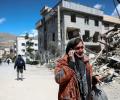
Fleur Hassan-Nahoum, special envoy, foreign ministry of Israel, has asserted that the situation has effectively been a "multi-front regional conflict" since its inception, while claiming significant military and strategic gains against adversarial forces.

Specifically, military experts are assessing if the 'Octopus' interceptor anti-drone system, produced in the UK to support Ukraine in countering Russian threats, could be repurposed to strengthen British protections against Iran's Shahed drones.

In the central Iranian city of Isfahan, residents gathered at Imam Square to protest the strikes and to mourn what state media termed the martyrdom of Ayatollah Khamenei. Demonstrators raised slogans including "God is great" as the airstrikes continued.

Israel and the United States had a plan. Iran punched back. And now the Gulf is reeling, the world is beginning to feel the pain and, as on date, no one in Washington or Tel Aviv appears willing to admit that the punch has landed, notes Prem Panicker, continuing his must-read blog on the war in the Middle East.

'What we have yet to see on either the US or the Iranian side is willingness to compromise on their ultimate demands and the flexibility to reach an agreement to end the war.

Trump has made it clear: the US will not lift its blockade of Iranian ports until a deal is signed.

Pakistan's Foreign Minister Ishaq Dar met with his counterparts from Egypt and Turkiye in Islamabad ahead of a quadrilateral summit, including Saudi Arabia, to discuss the ongoing conflict in West Asia and explore avenues for peace.
The Indian government is considering additional relief packages for vulnerable sectors like MSMEs to mitigate the impact of the ongoing West Asia crisis on the economy and inflation.

As the negotiations continued, the Iranian government said on social media that "talks between Iran and the US in Islamabad entered the expert-level stage as economic, military, legal, and nuclear committees joined in".

Iran has not closed the Strait. It remains open; however, due to current conditions and circumstances, ships are unable to pass through the Hormuz. Otherwise, Iran never wanted the Strait to be closed or blocked, the supreme leader's representative said.

Protests erupted in Kashmir following the killing of Iran's Supreme Leader Ayatollah Ali Khamenei, leading to restrictions on movement and mobile internet speeds.

US President Donald Trump stated that the decision regarding the conclusion of the conflict with Iran will be a 'mutual' decision made in coordination with Israeli Prime Minister Benjamin Netanyahu.

'Strikes into the Gulf countries are proof that the security guarantees offered by the US are ineffective and that the Gulf countries cannot rely on American security assurances for their safety.'

Iran has blamed the US for disruptions in oil and gas shipping through the Strait of Hormuz, citing 'destabilising actions' as the cause amid the ongoing West Asia conflict and rising energy prices.

16 days into the war, US forces were already running out of ground-attack missiles and Israel is about to expend its entire Arrow interceptor missiles by end March. To be sure, the Iranians are watching closely and that explains their defiant stance that 'Iran will end the war when it decides to do so and when its conditions are met', notes Ambassador M K Bhadrakumar.
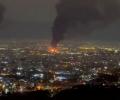
To be sure, Trump is furious, as the trajectory of the war is in a state of Zugzwang, as chess players call it. Trump and Netanyahu stare at two choices -- retreat in humiliation and concede Tehran's demands -- recognition of its rights, reparations, and binding security guarantees -- or perish in a quagmire, points out Ambassador M K Bhadrakumar.

Congress leader Shashi Tharoor is urging the Indian government to take a more proactive role in mediating the escalating conflict between the US-Israel alliance and Iran, emphasising the impact on India's energy security and regional stability.

Israeli Prime Minister Benjamin Netanyahu has threatened to continue targeting Iranian leaders, claiming recent successes in eliminating key figures. He asserted that Israel, with US support, aims to undermine the Iranian regime and empower the Iranian people.

Amid the ongoing conflict in West Asia, Israeli Ambassador to India, Reuven Azar, stated that Israel is willing to cease hostilities if Iran changes its course, emphasising that Tel Aviv has consulted diplomatic channels, including the US and regional partners.
